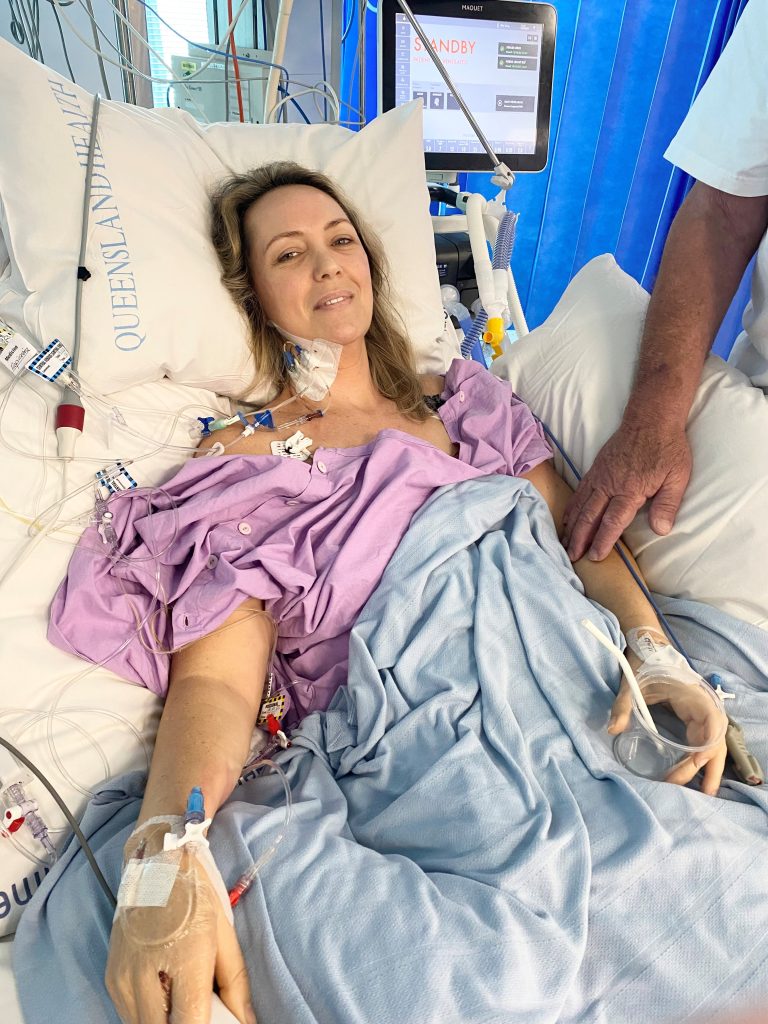
If there’s one thing Sunshine Coast make-up artist Natalie would like GPs to know, it’s that bowel cancer is not an old person’s disease.
“I know GPs are reluctant to refer younger people for further tests and colonoscopies, but in my case an earlier referral could have changed everything,” Natalie said.
Despite having no family history of bowel cancer, Natalie was diagnosed aged just 43 with state IV bowel cancer. The shock late-stage diagnosis meant the cancer was deemed ‘incurable.’
“I was young, fit, and healthy but when I think back, there were early red flags,” the mum-of-two said.
“I had low iron and stomach pains for a long time and went to the GP. He just said, ‘You have low iron,’ and told me to take iron supplements and said my stomach pains ‘may’ be irritable bowel or diverticulitis. There was no effort to find out the causes.”
Natalie thought she could fix these things with a good diet and wasn’t advised otherwise. Ultimately, the cancer diagnosis came when Natalie had been in excruciating pain for days.
What doctors had assumed to be constipation was diagnosed within 20 minutes of a CT scan at hospital as a large tumour in her sigmoid colon.
“The doctor looked at me, held my hand and said, ‘You’ve got bowel cancer. It’s a big tumour, and it’s spread to your liver’ “
Now, three years later, Natalie is still undergoing treatment. Having had the tumour removed from her bowel, and a large part of her liver removed, she received the news late last year that cancer had unfortunately spread to her lungs.
“Since the initial diagnosis, I’ve been monitored very closely so they found the tumours on my lungs much more quickly,” she said.
“I’ve been undergoing both chemotherapy and cryoablation, which freezes and removes cancer cells. I’m optimistic it’s working.”
While Natalie keeps up her optimism in the face of a challenging diagnosis, she’s conscious that the cancer initially started in her bowel and went undiagnosed for years.
Her message to GPs is simple: even if someone is young, you can still refer them for further testing because bowel cancer doesn’t discriminate based on age.
“I know there can be a lot of red tape, or concerns about over-referring, but if someone is having rectal bleeding and persistent changes in bowel habits – like darker and narrower stools – then don’t be afraid to send them for further testing,” Natalie said
“Catching bowel cancer at stage two or three vs at stage four makes a huge difference.”
Tiffany was 49 years old and living an active life on the Sunshine Coast when she began to feel unwell.
At first, she dismissed her symptoms as the result of an irregular routine after a recent trip around Australia with her husband.
Tiffany collapsed at home after losing two litres of blood and was rushed to the Emergency Department, where she required five units of blood.
Despite these alarming signs, she was told it was “likely a burst haemorrhoid” and prepared to send her home.
“They said it was a one-off event and to go home,” Tiffany said.
Her symptoms, severe rectal bleeding, fatigue, and rapid health decline, were clear red flags. Yet, when Tiffany asked for a colonoscopy, she was told there would be a six to nine month wait in the public system.
Determined to get answers, Tiffany invoked Ryan’s Rule, a Queensland initiative that allows patients to escalate concerns when their condition is worsening. After intense negotiations, she secured a colonoscopy within two weeks.
“If I hadn’t pushed, I wouldn’t be here today,” she said. “And this was despite having a family history of bowel cancer.”
Unfortunately, the procedure revealed advanced bowel cancer. Tiffany underwent radiation and chemotherapy in 2022 and now faces ongoing monitoring with regular scans.
Her experience underscores a critical issue across Australia: symptoms dismissed because of age and gender.
“Bowel cancer is increasingly impacting younger Australians, and assumptions based on age and gender can cost lives,” Tiffany said. “I urge all GPs, who are on the frontline of early detection, to take the time to engage with Bowel Cancer Australia and their great materials and courses to assist with early diagnosis.”

“The simple answer is – prompt referral for colonoscopy can save lives.”
When you’re a doctor, you get used to giving bad news and, to an extent, you learn to insulate yourself from it.
So, at just 33-years-old, it came as a huge shock to Dr Katherine Goodall that she would hear those dreaded words herself from her own doctor.
“Unfortunately, I found cancer.”
Dr Goodall was working at the Princess Alexandra Hospital in Brisbane when she was diagnosed, having relocated from Cairns during her surgical training. Her life and career were placed on hold for nine months while she underwent treatment.
“Chemotherapy really knocked me around, and I developed symptoms that any surgeon would dread, including hand-foot syndrome, and peripheral neuropathy,” Dr Goodall said.
“Chemotherapy really knocked me around, and I developed symptoms that any surgeon would dread, including hand-foot syndrome, and peripheral neuropathy”
“Fortunately, I found some amazing support from an occupational therapist and took up some hobbies that would help me recover. I was able to go back to surgical training part-time.
“I had been interested in colorectal surgery since I was an intern and have since decided to continue that pathway. So, I suppose you could say the experience of having bowel cancer myself, didn’t deter me from my chosen career.”
Dr Goodall is one of a growing number of young Australians who are being diagnosed with bowel cancer as one-in-eight new cases now occur in people aged under 50.
She wants to use her unique position as a surgeon-patient to advocate for GPs to recognise the early red flag signs of bowel cancer.
“In my own practice, I’ve learned not to ask questions like ‘have you noticed any rectal bleeding?’ or ‘have you changed your bowel habits?’ because patients don’t know what that means”
“Instead, I ask, ‘in the past 12 months, have you changed how many times a day you go to the toilet?’ or ‘have you noticed any changes to the colour or consistency of your poo?’
“But my standard question is simply, ‘Is there anything new about your poo?’”
Dr Goodall said she’d like to encourage GPs to refer more ‘grey-area’ patients.
“That one you are on the fence about? I would love to meet that patient,” she said.
“All professionals have missed opportunities for finding cases – not just GPs – because it is hard to pinpoint which patient with PR bleeding needs urgent intervention. We can work together to figure it out.”